18 Dec 2009
I just noticed Tom Forsyth, aka tomf, is speaking at the
Stanford EE CS Colloquium on January 6, 2010. The
video will hopefully be posted on the web afterwards.
The topic is “To be announced”, but is very likely to be Larrabee related.
26 Nov 2009
I’m writing a skinning sample for a future Android SDK. This has prompted me
to construct a toolchain to get skinned animated models into Android
applications.
I’m really only just getting started, but so far I’m thinking along these
lines:
Wings 3D -> Blender 2.5 -> FBX ASCII -> ad-hoc tool -> ad-hoc binary file ->
ad-hoc loader.
For what it’s worth, right now Blender 2.5 doesn’t support FBX export, so I
have to do Collada -> FBX Converter -> FBX. But Blender 2.5 support should be
ready fairly soon.
You may wonder why I’m considering using the proprietary and undocumented FBX
standard rather than the open source Collada standard. I’m doing it for the
same reason so many other tool chains (e.g. Unity, XNA) do, namely that FBX is
a simpler format that just seems to work more reliably when exchanging data
between DCC applications.
26 Nov 2009
The open-source Blender 3D DCC tool has long
suffered from an ugly, non-standard, hard-to-learn UI. I’m very happy to see
that the latest release, which just entered alpha status, has a much improved
UI. It’s not quite Modo quality, but it’s starting to get into the same league
as commercial DCC tools.
25 Nov 2009
Yahoo continues to be a source of excellent information on recent and future
versions of JavaScript / ECMAScript. Here are two very good talks from
November 2009 about the evolution of JavaScript from 2000 until now:
Doug Crockford on ECMAScript 4/5
Brendan Eich on ECMAScript 4 / 5 and Harmony
25 Nov 2009
In the late 1980’s Jordan Mechner single-handedly designed and programmed the
original Apple II version of
Prince of Persia and
several other groundbreaking games. He published his
development journals and
technical design documents on his web site.
The journals touch on:
- The development of the stop-motion animation techniques used so effectively in PoP
- The tension in Jordan’s life between his two callings: game development and feature film scriptwriting / directing.
- The difficulties involved in developing and selling a new game idea.
- A view into the late 80’s / early 90’s pre-web game development business.
Although many games are now written by large teams of people, in the end, a
lot of the business, artistic, and technical issues Jordan writes about remain
relevant. I highly recommend these journals for anyone interested in an inside
view of game development. (Or anyone interested in trying to break into
Hollywood. :-) )
11 Nov 2009
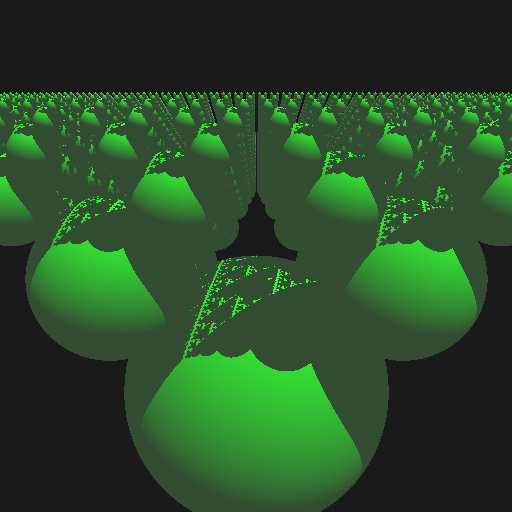
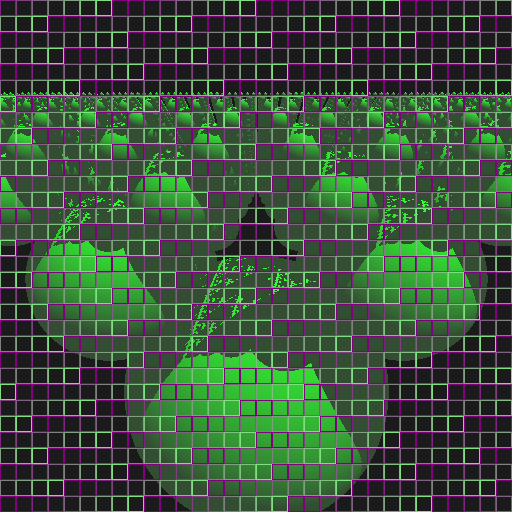
Above is the output of the raytracer. Below is a diagnostic mode showing which
goroutines raytraced which section of the screen. Each goroutine has its own
color to outline the pixels it traces:
I wrote a simple multi-threaded ray tracer in Google’s new “go” language. It’s
an adaptation of Flying Frog Consultancy’s
Raytracer.
It runs single-threaded about 1/2 the speed of a comparable C++ version. I
guess the C++ version benefits from a more optimizing compiler and the ability
to inline small functions.
Compared to ordinary C/C++, the Go version was easier to multithread.
On my dual-core Macbook Pro I get an 1.80x speedup when running with
GOMAXPROCS > 1:
$ GOMAXPROCS=1 time ./gotrace

**1.52** real 1.50 user 0.01 sys

$ GOMAXPROCS=2 time ./gotrace

**0.82** real 1.50 user 0.01 sys

$ GOMAXPROCS=3 time ./gotrace

**0.81** real 1.50 user 0.01 sys
On an eight-core, 16 Hyperthread HP Z600 running Ubuntu 9.10, (with the source
code changed to use 16 goroutines instead of the default 8 goroutines) I get a
5.8x speedup:
$ GOMAXPROCS=1 time ./gotrace

1.05user 0.01system 0:01.06elapsed 99%CPU (0avgtext+0avgdata 0maxresident)k

0inputs+1544outputs (0major+2128minor)pagefaults 0swaps

$ GOMAXPROCS=16 time ./gotrace

1.32user 0.00system 0:00.18elapsed 702%CPU (0avgtext+0avgdata 0maxresident)k

0inputs+1544outputs (0major+2190minor)pagefaults 0swaps
Source code gotracer.zip
07 Nov 2009
I’ve been working part time on the “Droid” project for the last year, and it
finally shipped today. I wrote some of the graphics libraries.
At first I was skeptical of the industrial design. The early prototypes looked
very much like a 1970’s American car dashboard. But Motorola really improved
the industrial design in subsequent versions. I like the high-grip rubber on
the battery cover. It makes the phone very comfortable to hold.
The phone hardware is very fast, and the high resolution screen is beautiful.
I think people will enjoy owning and using this phone.
My favorite feature is the turn-by-turn navigation software. My second
favorite feature is the “Droooid” default notification sound. Oh, and the
camera flashlight is very nice too!
07 Nov 2009
Man, the web really does change everything!
The company “Demand Media” has
developed a Google-like business model for creating how-to videos:
- Use data mining to figure out what people are searching for.
- Use semantic database to figure out what their search queries mean. (e.g. “how to draw a gun” vs. “how to draw a flower”.)
- Find out how much advertisers are willing to pay for an ad that appears next to the video.
- Look at how much content already exists to answer the question.
- Use 1-4 to calculate the expected lifetime value of the how-to video.
- Automate the process of matching freelance writers, videographers, editors, and fact checkers to create the video as inexpensively as possible. (In the $30 per video range.)
- Host the resulting videos on Youtube (and other video sites) and monetize with ad keywords.
They say that the algorithm produces lifetime values about 5 times higher than
human editors do.
These guys have basically automated the “How to” video market. Amazing! I
wonder if they will move up the video food chain into music videos, TV shows
or movies? It might work for low budget children’s programming.
Or even for casual games. Hmm.
20 Oct 2009
I was pleasantly surprised to see that the latest version of Ubuntu, 9.10 b1,
comes with a nice selection of desktop backgrounds. This makes a huge
difference in how beginners perceive the product, at very little cost to
Ubuntu. The new dark-brown default color scheme is also an improvement over
the older schemes.
19 Oct 2009
Now that the Android Native Development Kit has been released, I was finally
able to publish the sources and binary to my Android Terminal Emulator.
It’s a fairly plain Digital Equipment Corporation VT-100 terminal emulator, with some features from newer
terminals (like colors.)
This is my first application in the Android Market. There are at least 10
other terminal emulators in the market; we’ll see how this one is received.
A bit of history: This was my first Android application. I wrote it for the
original “Sooner” Android devices, and have kept it updated for the successive
generations of devices. It requires native code because there’s no public
Android Java APIs for dealing with PTYs.
A bit of ancient history: I wrote two terminal emulators for the Atari 800
back in the day: Chameleon, in 6502 assembly, and a version of Kermit in the
excellent “Action!” programming language. Kermit was one of my first “open
source” programs. If you poke around on the web you can still find it
here and there.